Post-Market Surveillance & Monitoring

Post-Market Surveillance (PMS) is the systematic monitoring of a medical device after it has been placed on the market.
Post-Market Clinical Follow-up (PMCF) is the clinical component of this: the ongoing collection and evaluation of clinical data on the actual product.

Both are mandatory under the MDR (EU) 2017/745, must be planned prior to CE marking, and must be maintained throughout the product’s entire lifecycle. PMS answers the question, “What happens to the product on the market?” PMCF answers the question, “Does the clinical evidence hold up over time?”

Post-Market Surveillance (PMS) & Post-Market Clinical Follow-Up (PMCF)

If you intend to sell your medical device in the European Economic Area (EEA), you must comply with the mandatory requirements of Post-Market Surveillance (PMS) and Post-Market Clinical Follow-Up (PMCF) under the European Medical Device Regulation [1]. These requirements apply to all classes of medical device and are essential for ensuring ongoing compliance, safety and performance following CE Marking.

Post-Market Surveillance (PMS) is a proactive and systematic process designed to collect and analyze data from Medical Devices already in use on the market. The goal is to derive Corrective and Preventive Actions (CAPA) and maintain patient safety.

Post Market Clinical Follow-Up (PMCF) is defined as an ongoing process for updating the clinical evaluation and must be included in the PMS plan. Medical Device Manufacturers collect and evaluate clinical data as part of the PMCF. This process must be conducted proactively and takes place after the medical device has been affixed with a CE mark. Naturally, this process must be described as a documented procedure within the Quality Management System (QMS).

The purpose of Post Market Clinical Follow-Up activities is to use the product in accordance with its intended use while demonstrating its safety and performance throughout the product’s lifespan. The activities are intended to identify and assess unknown risks to ensure that these risks are acceptable.

Post-Market Surveillance & Monitoring

PMS · Article 83–86

Post-Market Surveillance

The objective is to identify and minimize risks, continuously assess device performance, and update Technical Documentation and Risk Management where necessary.

PMCF · Annex XIV, Teil B

Post-Market Clinical Follow-Up

These activities are expected to be initiated before market entry and continued throughout the device lifecycle.

Integration in the Product Lifecycle

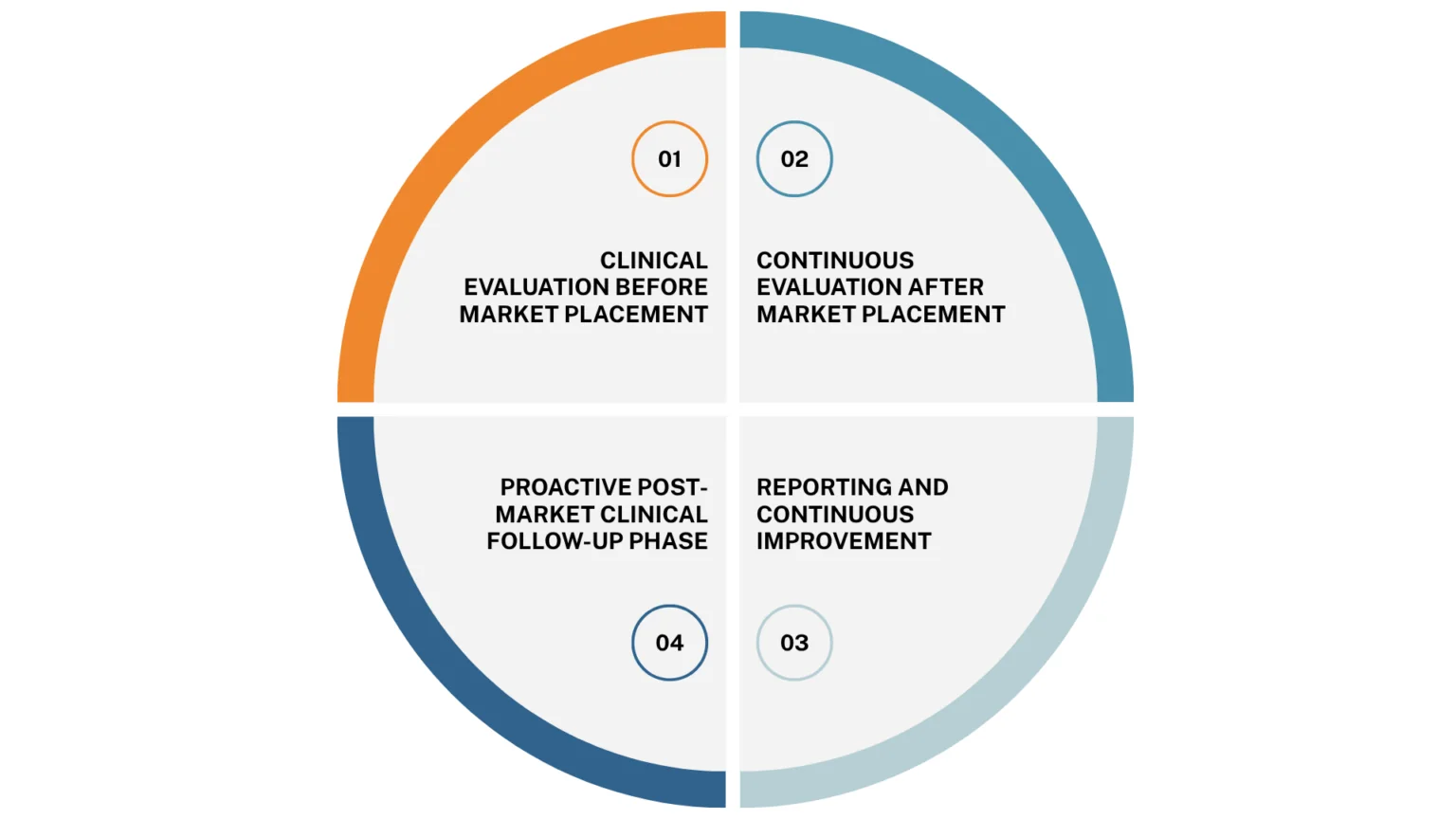
Post-Market Surveillance (PMS) and Post-Market Clinical Follow-Up (PMCF) are not isolated, separate measures. They form a continuous process that begins even before CE marking and continues throughout the entire product lifecycle. According to MDR Article 61(11), the clinical evaluation must be continuously updated with real-world data.

The entire cycle is supported by ISO 13485 Quality Management and EN ISO 14971 Risk Management, which describe the processes that apply at every stage of the product life cycle.

1. Clinical Evaluation before Market Placement

Before a medical device is made available on the market, the manufacturer must conduct a clinical evaluation.

The clinical evaluation is based on a systematic and planned approach to the collection, analysis, and assessment of clinical data. This process includes:

  • the planning and identification of (expert) sources,
  • the evaluation of data based on established criteria,
  • the analysis of relevant data with regard to the performance and safety of the medical device,
  • and the structured, traceable documentation of methodology and results.

2. Continuous Post-Market Evaluation

According to MDR Article 61(11), the clinical evaluation must be continuously updated based on real-world data collected through PMS and PMCF activities.

This means that even after CE marking, manufacturers must  be implemented and maintained over the product life cycle:

  • a PMS plan (for the collection and evaluation of post-market information)
  • and a PMCF plan (for the collection of clinical data under real-world conditions).
Post-Market Surveillance (PMS) and Post-Market Clinical Follow-Up (PMCF) are not isolated, separate measures. They form a continuous process that begins even before CE marking and continues throughout the entire product lifecycle. According to MDR Article 61(11), the clinical evaluation must be continuously updated with real-world data.

4. Proactive Phase of Clinical Follow-up

The proactive PMCF phase serves to confirm the safety and performance of the product throughout its entire lifecycle. It is an ongoing process designed to regularly update the clinical evaluation (MDR, Annex XIV, Part B (5); Figure 1, No. 3).

Clinical data can be generated as part of PMCF through various measures, such as:

  • product registries that monitor the effectiveness and safety of medical devices,
  • PMCF studies, which will be discussed in more detail below.

3. Reporting and Continuous Improvement

The results of PMCF activities must be analyzed and documented in a PMCF evaluation report (MDR, Annex XIV, Part B (7)).

The report must meet the following requirements:

  • Clinical evaluation requirements,
  • Risk management requirements,
  • Compliance with the GruSuLa guidelines,
  • Assessment of adverse events and justification of the benefit-risk ratio,
  • Updating of the risk management system and the technical documentation as part of the clinical evaluation.

This final step brings the process full circle by feeding the results back into the clinical evaluation and continuously improving them based on real-world data. This creates a continuous cycle of vigilance and regulatory compliance.

Need more information?

WQS provides you with detailed information on your subject.
You can also explore our FAQ page and other resources for further insight
– or simply contact us for direct support.

Frequently Asked Questions

Post-Market Surveillance (PMS) is a proactive and systematic process mandated by the EU MDR to monitor the safety, performance, and compliance of a Medical Device after it has been placed on the market. It involves gathering data from real-world use to detect risks early and take corrective or preventive actions.

Post-Market Clinical Follow-Up (PMCF) is an essential part of PMS that focuses on collecting clinical data after a device has entered the market. It confirms that the device remains safe and effective throughout its lifetime and identifies unknown side effects or deviations from intended use.

Yes, both Post-Market Surveillance (PMS) and Post-Market Clinical Follow-Up (PMCF) are mandatory under the MDR for all risk classes – from Class I to Class III. The level of scrutiny and clinical follow-up increases with the device’s risk class.

A PMS Plan should outline methods for collecting, evaluating, and responding to post-market information. This includes feedback from users, adverse event reports, incident trends, scientific publications, registry data and updates to technical documentation.

PMCF activities can include post-market clinical studies, user surveys, patient registries, observational data analysis, and literature reviews – always under real-use conditions and within the device’s intended purpose.

Post-Market Surveillance (PMS) and Post-Market Clinical Follow-Up (PMCF) are part of the lifecycle approach to regulatory compliance. Planning must begin before CE Marking, and both continue after market entry to maintain the validity of the CE Certification over time.

While Post-Market Surveillance (PMS) includes all forms of post-market data gathering, Post-Market Clinical Follow-Up (PMCF) is specifically focused on clinical data collection and evaluation under real-world conditions to support the ongoing clinical evaluation.

Sources and Regulatory Basis

  • European Parliament & Council of the EU: Regulation (EU) 2017/745 on Medical Devices (MDR), Official Journal of the European Union, May 5, 2017 – eur-lex.europa.eu
  • EN ISO 13485:2016 + AC:2018 + A11:2021 Medical devices: Quality management systems — Requirements for regulatory purposes
  • Medical Device Coordination Group (MDCG): Post-market Clinical Follow-up (PMCF) Plan Template – A Guide for Manufacturers and Notified Bodies (MDCG 2020-7), April 2020 – health.ec.europa.eu
  • EN ISO 14971:2019 + A11:2021 Medical devices: Application of risk management to medical devices, Beuth Verlag GmbH

This page provides regulatory information and does not constitute legal advice. Regulatory requirements vary by jurisdiction.