
Medical Devices in India are regulated by the Central Drugs Standard Control Organization (CDSCO) in accordance with the Medical Device Rules, 2017 (MDR 2017). Products are classified into risk classes A, B, C, and D on a risk-based basis (First Schedule).
The Central Licensing Authority has full authority over imports, regardless of the risk class. The application is submitted on Form MD-14, and the import license is issued on Form MD-15 (Rule 34). The applicant is not the manufacturer, but an Authorized Indian Agent holding their own wholesale or manufacturing license or an MD-42 registration certificate.
The core documents are the Device Master File (DMF) in accordance with Appendix II and the Plant Master File (PMF) in accordance with Appendix I of the Fourth Schedule, supplemented by a Free Sale Certificate, an ISO 13485 certificate, a CE certificate or FDA verification, and an apostilled Power of Attorney.
AUTHORITY
Central Drugs Standard Control Organisation
LEGAL BASIS
Medical Device Rules, G.S.R. 78(E)
APPLICATION / LICENSE
Application Form → Import License
LOCAL REQUIREMENT
Legal entity, not a private individual
The Indian government recognizes four risk classes, A through D. The system is similar to the EU MDR. However, an EU Class IIa device does not automatically correspond to an Indian Class B device.
The determining factors are intended use, invasiveness, duration of contact, whether the device is active or implantable, and the overall risk. The classification determines the process, scope of documentation, and fees.
| Class | Risk | Import Authority | License Required | Note |
|---|---|---|---|---|
| A | Low | Central Licensing Authority | MD-14 / MD-15 (exempt if non-sterile and non-measuring: registration only) | FSC from EU/US supports the application |
| B | Low to medium | Central Licensing Authority | MD-14 / MD-15 required | FSC from EU/US supports the application |
| C | Medium to high | Central Licensing Authority | MD-14 / MD-15 required | Higher clinical evidence requirements; FSC helps avoid a new clinical investigation |
| D | High | Central Licensing Authority | MD-14 / MD-15 required | Most thorough review; on-site inspection possible; FSC helps avoid a new clinical investigation |
*FSC: Free Sales Agreement
In India, the CE marking and FDA clearance are supporting documents that accompany the application, but they do not replace it. The CDSCO conducts its own review and issues its own license. However, a large portion of the EU/FDA documentation can be reused:
More specifically, you do not submit your technical documentation. Instead, you adapt it to the formats required by the CDSCO.
The most common mistake is that manufacturers interpret Classes A and B based on the State Licensing Authority and plan accordingly. However, this only applies to manufacturing in India. For imports, the Central Licensing Authority is always responsible, even for Class A devices.
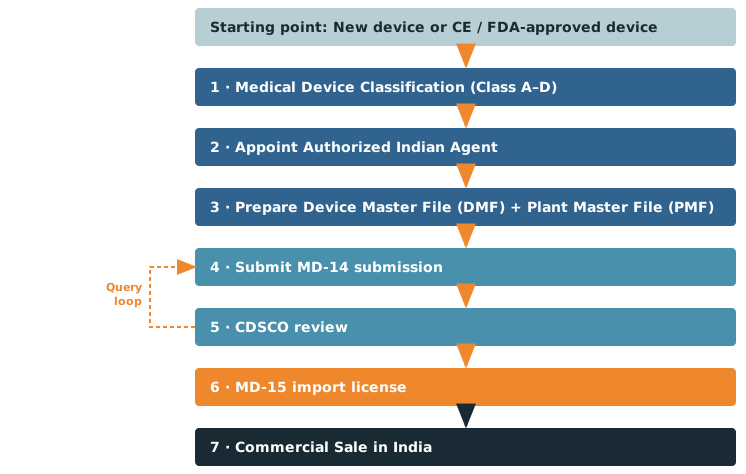
The approval process for medical devices in India involves several steps. The following diagram shows the complete process, from classification under the Medical Device Rules 2017 through the Authorized Indian Agent, Device Master File, and Plant Master File, to the submission of the MD-14 application and the issuance of the MD-15 import license.
The majority of this information is already included in your MDR technical documentation. However, CDSCO expects specific formats and a specific line of reasoning.
In accordance with Fourth Schedule, Appendix II. Includes, among other things:
Most of this information is already included in the EU technical documentation.
According to Fourth Schedule, Appendix I. Describes the manufacturing site and quality system:
Other generally required documents include:
The Indian market requires separate registrations and a local authorized agent. We review your existing MDR or FDA dossier against CDSCO requirements and clarify the requirements for your product.
No. India does not recognize the CE marking as approval. It serves as a supporting document in the CDSCO application. The CDSCO conducts its own review and issues its own import license on Form MD-15. The product may not be imported without Form MD-15.
MD-14 is the application form for the import license. MD-15 is the import license itself, issued by CDSCO. These are not two separate licenses, but rather the application and the approval notice. The application is submitted by the Authorized Indian Agent via the MD Online Portal.
The Central Licensing Authority is exclusively responsible for imports, regardless of the product’s risk class. The State Licensing Authority’s jurisdiction over Classes A and B applies exclusively to manufacturing within India, not to imports.
The MD-15 is valid indefinitely as long as the retention fee is paid. This fee is due every five years, calculated from the date of issuance of the base license. Additionally, updated documents must be submitted, including the ISO 13485 certificate, Free Sale Certificate, and PMS data for the past five years. A late payment fee applies in the event of delayed payment.
For the most part, yes. The Technical Documentation, the Clinical Evaluation Report, the Risk Management File, PMS and PMCF documentation, and the ISO 13485 certificate provide the foundation.
However, the formats are different. CDSCO requires a Device Master File in accordance with Appendix II and a Plant Master File in accordance with Appendix I of the Fourth Schedule. A conversion is necessary.
The duration depends on the risk class and the completeness of the dossier. For imports, the application is always reviewed by the Central Licensing Authority, regardless of the risk class. Class A and B devices are typically processed within about 4 to 6 months, while Class C and D devices usually take 6 to 9 months or longer due to higher clinical evidence requirements and possible site inspections. The import license (MD-15) is issued after review of the Device Master File and Plant Master File. Queries from the authority regularly extend the process, which is why a complete, well-prepared dossier is the most effective way to shorten the timeline.
This page provides regulatory information and does not constitute legal advice. Regulatory requirements vary by jurisdiction.

Support for US companies to enter the European market. EU Rep, Certification, QM System, Technical Documentation, support of the Procedure, selection of a Notified Body, support of the Certification Procedure, preparation of a Clinical Evaluation, support of Clinical Studies, including the Logistical Concepts.
Copyright 2026 WQS Management Consultants GmbH – Alle Rechte vorbehalten
This page provides regulatory information and does not constitute legal advice. Regulatory requirements vary by jurisdiction.
Image note: Certain images and photos used on this page were created or edited, in whole or in part, with artificial intelligence.