International Approval for Medical Devices

Compliant International Approval of Medical Devices

In addition to the approval and registration of your medical devices in Europe and the United States, WQS also coordinates the approval process for other markets. We offer support for entering medical device markets and guide you through the international approval process.

Thanks to our global network of experienced partners and regulatory experts, we ensure that your products efficiently meet the respective country-specific requirements. This allows you to focus on expanding your business across borders.

What is the international approval process for medical devices?

International approval refers to the registration and conformity assessment of a medical device across multiple national regulatory systems. Each market requires its own documentation: the EU through the MDR (EU) 2017/745 with CE marking and a Notified Body; the U.S. through the FDA with 510(k), De Novo, or PMA; and India through the CDSCO in accordance with the Medical Device Rules 2017.

The substantive requirements overlap to a large extent. Proof of safety and performance, risk management according to EN ISO 14971, clinical data, and a quality management system according to ISO 13485 are required almost everywhere. What differs are the format, the reviewing authority, deadlines, and the requirement for a local representative. Harmonized technical documentation, such as in the GHTF’s STED format, significantly reduces the effort required for each additional market.

Our Target Markets

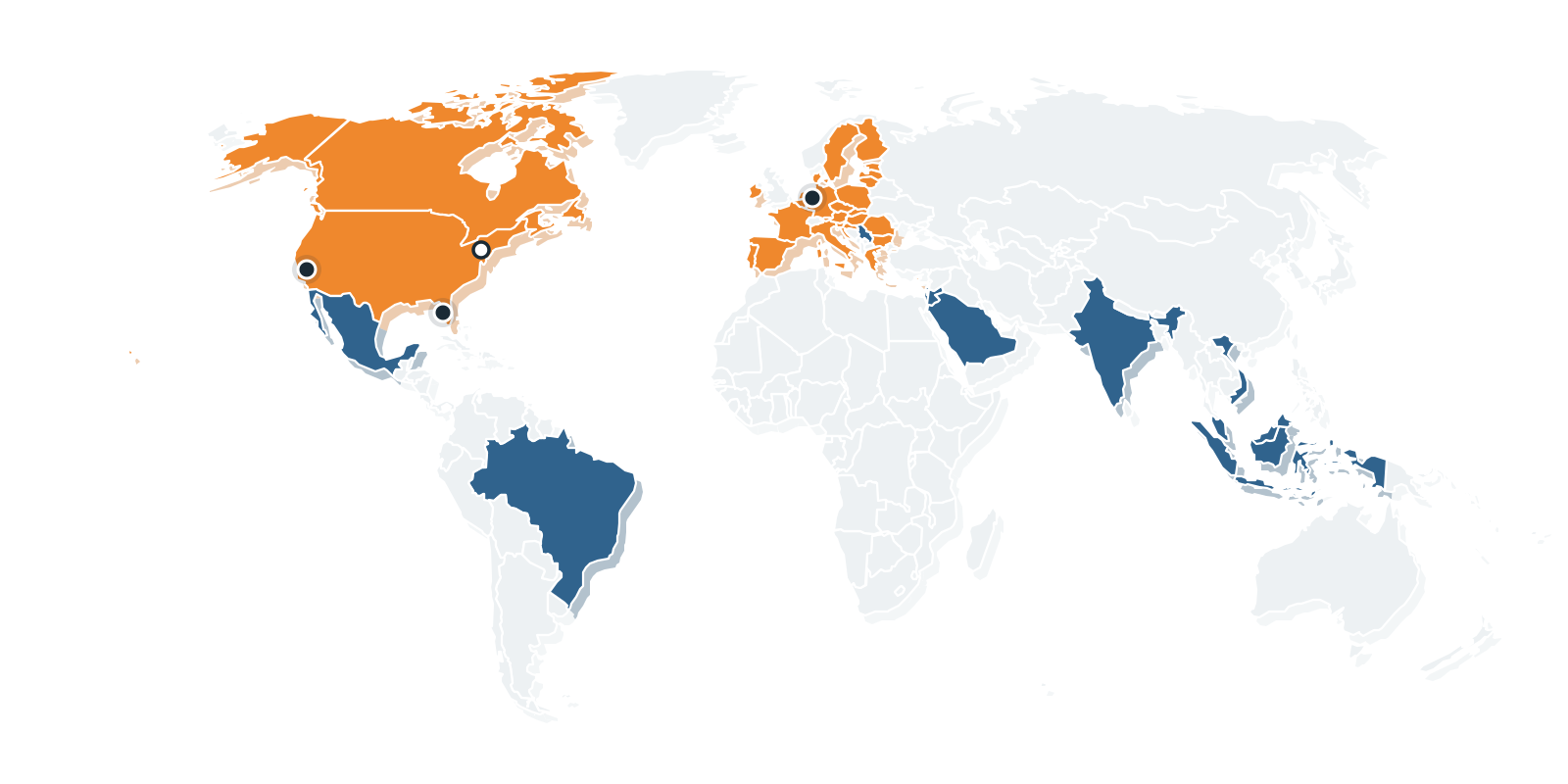
We have already successfully supported medtech companies in obtaining approval in the following regions:

International approval refers to the registration and conformity assessment of a medical device across multiple national regulatory systems. Each market requires its own certification: the EU through the MDR (EU) 2017/745 with CE marking and a Notified Body; the U.S. through the FDA with 510(k), De Novo, or PMA; and India via the CDSCO under the Medical Device Rules 2017. In addition to the approval and registration of your medical devices in Europe and the United States, WQS also coordinates the process for other markets. We offer support for entering medical device markets and guide you through the international approval process.

EUROPEAN UNION

MDR (EU) 2017/745: CE Certification

Market access in the EU is granted through conformity assessment in accordance with the MDR. Starting with Classes Is/Im/IIa, a Notified Body conducts the assessment. The technical documentation must provide evidence of GSPR compliance, clinical evaluation, a post-market surveillance (PMS) system, and UDI assignment. Manufacturers not based in the EU also need a European Authorized Representative and a PRRC.

We review the documentation before submission. In addition, we conduct various tests in our laboratory.

USA & CANADA

FDA: 510(k), De Novo, PMA

In the U.S., the product class determines the regulatory pathway: Class II via 510(k), Class III via PMA and De Novo. There are also additional regulations for manufacturers not based in the U.S. Since the QMSR, ISO 13485:2016 has been the basis of the quality system; 21 CFR Part 820 has been updated. Canada requires a Medical Device License under the Medical Devices Regulations, based on an MDSAP certificate.

With our locations in Florida and California, we conduct the process on-site. Our cleanroom is also available in Pennsylvania.

INDIA

CDSCO: Medical Device Rules 2017

In India, medical devices are regulated by the CDSCO in accordance with the Medical Device Rules of 2017. Classification of products is into Classes A through D. Responsibility for imports, regardless of risk class, lies with the Central Licensing Authority. Applications are submitted on Form MD-14 by an authorised Indian Agent based in India. The import licence is issued on Form MD-15.

WQS employs staff in India and provides on-site support for dossier preparation, agent selection, and communication with regulatory authorities.

INTERNATIONAL MARKETS

Additional Approval Procedures

How can technical documentation be harmonized internationally?

Regulatory requirements vary from country to country, but the core information required is often very similar. To expedite approval processes, the Technical Documentation should therefore be prepared in an internationally recognized format.

The STED File (Summary Technical Documentation for Demonstrating Conformity to the Essential Principles of Safety and Performance of Medical Devices), developed by the Global Harmonization Task Force (GHTF), has proven effective. It serves as evidence for conformity assessment and structures the fundamental safety and performance requirements in a way that is recognized in many jurisdictions. A core set of documentation is compiled, including product-specific evidence: a risk management file in accordance with EN ISO 14971, verification and validation reports, clinical data, process validations, and QMS evidence in accordance with ISO 13485.

Surrounding these are the market-specific modules: GSPR checklist and clinical evaluation for the EU, 510(k) summary and predicate device comparison for the FDA, and Device Master File and Plant Master File for the CDSCO.

Contact us for a quote on registering medical devices for the international market.

How does the international regulatory approval process work with WQS?

1

Market Analysis & Classification

Prioritize target markets, classify the product by regulatory jurisdiction, and determine the approval pathway and realistic timeline.

2

Documentation Gap Analysis

Compare existing documentation against the requirements of each target market.

3

Harmonized Core Documentation

Build a reusable dossier in STED format, supplemented with market-specific modules.

4

Submission & Local Representation

Notified Body, FDA, or CDSCO. Authorized Representative, U.S. Agent, or Indian Agent.

5

Follow-Up Requests & Maintenance

Respond to deficiency letters, PMS, PMCF, recertification, and license renewal after approval.

Are you choosing the international route?

We review your documentation against the requirements of your target markets.
Since 1993, with offices in Hamm, Florida, and California, a laboratory in Pennsylvania, and our own staff in India.

Frequently Asked Questions About International Approval of Medical Devices

International approval refers to the registration and conformity assessment of a medical device across multiple national regulatory systems. Each market requires its own evidence of compliance under its own laws: the EU via the MDR (EU) 2017/745, the U.S. via the FDA, and India via the CDSCO. There is no globally valid approval, and there is no automatic recognition between these systems.

No. The CE marking certifies compliance with European law. For the U.S. market, a separate procedure with the FDA is required: depending on the product class, this may be a 510(k), De Novo, or PMA. Additionally, Establishment Registration, Device Listing, and, for manufacturers not based in the U.S., a U.S. Agent are required. Much of the evidence from the technical documentation can be reused, but the procedure itself cannot.

The STED format developed by the Global Harmonization Task Force is accepted in numerous markets as the structure for technical documentation, including Canada, Australia, Brazil, and several Asian countries. It does not replace national procedures, but it significantly reduces the effort required to adapt documentation for each target market, as the core content of the documentation remains identical.

The duration depends on the risk class and the completeness of the dossier. Classes A and B are handled by the State Licensing Authority, while Classes C and D are handled by the Central Licensing Authority. Import licenses in the form of MD-15 are issued after review of the Device Master File and Plant Master File. Inquiries from the authority regularly prolong the process.

In most markets, yes. The EU requires a European Authorized Representative under MDR Article 11 if the manufacturer is not established in the Union. The U.S. requires an U.S. Agent. India requires an Authorized Indian Agent with a valid wholesale license.

ISO 13485 is the common standard. The EU requires a QMS under MDR Article 10; the FDA, following the QMSR alignment, requires a system based on ISO 13485:2016 under 21 CFR Part 820; and India requires compliance with the requirements of Schedule 5 of the Medical Device Rules. A certified ISO 13485 system covers the core requirements but does not exempt companies from country-specific additional requirements.

The costs consist of regulatory and testing fees, costs associated with the Notified Body, expenses for documentation and, if applicable, clinical data, as well as the costs of local representation. They vary significantly depending on the risk class and market. A reliable estimate can only be provided after classification and a gap analysis. Request a gap analysis from WQS now.

It makes sense to start with the market whose requirements are the most comprehensive and whose documentation can be reused: typically the EU or the U.S.. Additional markets can be served with less effort using this core documentation. Those who start with a secondary market and do not design their documentation for reuse will have to rebuild it later.

This page provides regulatory information and does not constitute legal advice. Regulatory requirements vary by jurisdiction.