Medical Devices Market Europe

Placing Medical Devices on the European Market

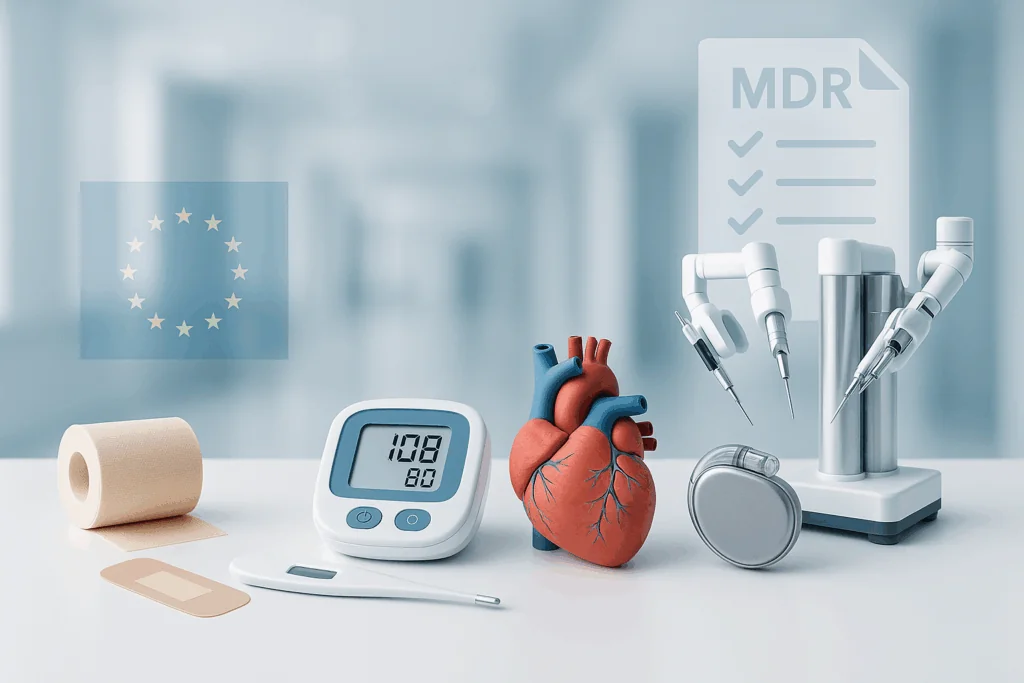
Medical Devices are an essential element of healthcare by helping to diagnose, treat, monitor or alleviate medical conditions. They include a wide range of products, from simple everyday products like bandages to complex high-technologies like heart implants, and even medical software.

Placing Medical Devices on the European Market. Medical Devices are an essential element of healthcare by helping to diagnose, treat, monitor or alleviate medical conditions. They include a wide range of products, from everyday products like bandages to complex technologies like heart implants.

Europe is the 2nd largest MedTech Market

with 26.4 % of the Global Medical Device Market

A region with strong potential

Predicted Market Volume of €103.31 billion in Europe in 2025

Top segments globally

In-Vitro Diagnostics (IVD), Cardiology,
Diagnostic Imaging

In the European Union (EU), Medical Devices are regulated under the Medical Device Regulation MDR (EU) 2017/745, a comprehensive and harmonized framework designed to ensure safety, performance, and clinical benefit for patients. These regulations are often seen as more adaptable to the diversity and fast-paced innovation of the Medical Device Industry than the U.S. FDA approval system.

Medical Devices have to pass a conformity assessment to ensure that they comply with the applicable regulations. This includes testing the safety, performance and quality of the product according to the applicable standards. After successfully passing the assessment, the products receive the CE Mark, which confirms that they comply with the EU Directives.

What is a medical device under the MDR?

The MDR (Article 2) defines a “Medical Device” as any instrument, apparatus, appliance, software, implant, reagent, material or other article intended by the manufacturer to be used, alone or in combination, for human beings for one or more of the following specific medical purposes:

  • Diagnosis, prevention, monitoring, prediction, prognosis, treatment or alleviation of disease
  • Diagnosis, monitoring, treatment, alleviation of or compensation for an injury or disability
  • Investigation, replacement or modification of the anatomy or of a physiological or pathological process or state
  • Providing information by means of in-vitro examination of specimens derived from the human body, including organ, blood and tissue donations

The decisive part is the end of the definition: the principal intended action is not achieved by pharmacological, immunological or metabolic means, such means may assist the action, but must not carry it.

The complexity of the EU System and what it means

Before a Medical Devices reaches the EU market, it has to pass a conformity assessment to ensure that they comply with the applicable regulations. This includes testing the safety, performance and quality of the product according to the applicable standards. After successfully passing the assessment, the products receive the CE Mark, which confirms that they comply with the EU Directives.

In contrast to the centralized U.S. system, the European model relies on Notified Bodies, independent organizations that are designated to assess the conformity of products. This decentralized model allows for faster access to the market and encourages continuous improvement.

Safety does not end at market entry. It is monitored through a Vigilance System. Manufacturers, distributors and healthcare professionals are required to report adverse events and incidents related to Medical Devices. This information is analyzed to identify potential risks and take appropriate action to ensure patient safety.

Is CE marking in the EU mandatory?

For medical devices placed on the EU market, CE marking is mandatory. It confirms that the product meets the applicable EU requirements and has passed a conformity assessment. 

How does the CE process work?

The path to CE marking follows the risk class. Define the intended purpose and classification, build the technical documentation, demonstrate the general safety and performance requirements, set up quality management, involve the Notified Body from Class IIa upward, issue the declaration of conformity and place the CE mark.

What does a Notified Body do?

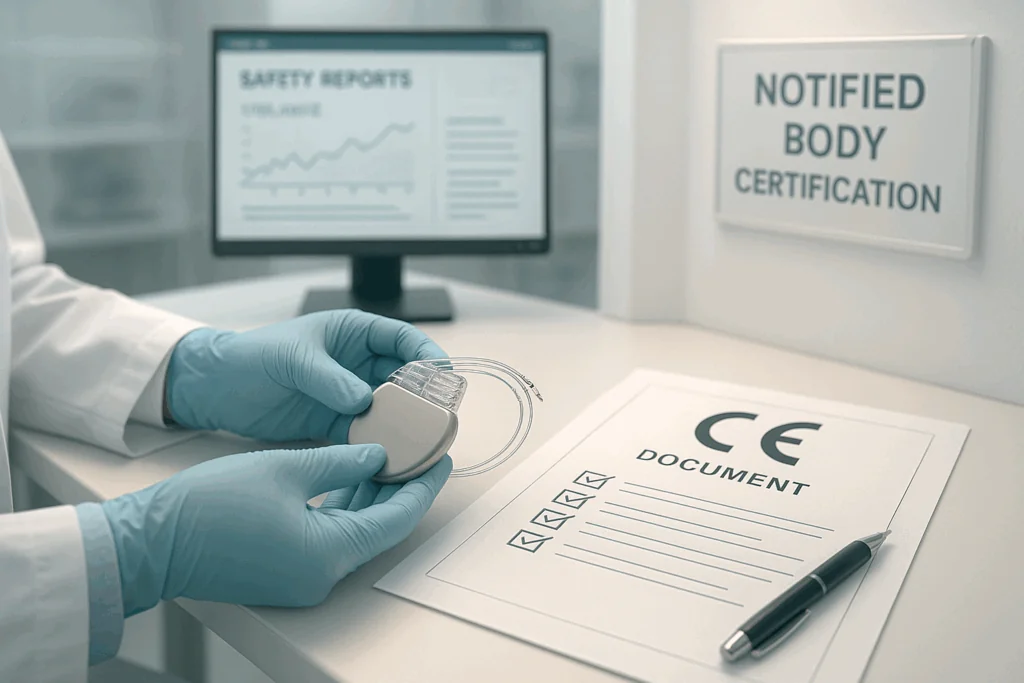
A Notified Body is an independent, government-designated assessment organization in the EU. It reviews the technical documentation, audits the quality management system and issues the certificates for CE marking. It does not develop or.

When do I need a Notified Body?

Class I products are generally placed on the market by the manufacturer under their own responsibility. Exceptions that involve a Notified Body: measuring function (Im), sterile condition (Is), reusable surgical instruments (Ir). From Class IIa upward, a Notified Body is mandatory.

Consulting Services for Medical Devices

WQS supports the regulatory process for medical devices and in vitro diagnostic medical devices, from clinical evaluation through technical documentation to registration and covers the entire path to market access.

Collection and analysis of clinical data before and after market launch

Biological Evaluation

Biocompatibility and biological safety of a medical device

Usability

Evaluation of a reusable medical device

Active medical devices

Software lifecycle and requirements for AI-based functions

Quality, safety, and shelf life of materials and packaging

Functionality and ensuring IVD compliance with the IVDR

Risk assessment according to EN ISO 14971 to protect patient health

Graphic symbols for labeling, UDI (device and production identification), and EUDAMED registration

Distinction: medical device or pharmaceutical?

Distinguishing between a medical device and a medicinal product.
The distinction between the two lies in their mechanism of function. Pharmaceuticals act pharmacologically, immunologically or metabolically. Medical devices, on the other hand, act mechanically, physically or thermally. In borderline cases, such as substance-containing products, the principal action determines the entire approval process.

Examples: from bandage to implant

The range of medtech is wide: bandages, contact lenses, wheelchairs, infusion pumps, surgical instruments, pacemakers, imaging systems and software with a medical intended purpose. What connects them is not the technology, but the medical purpose.

"Medical Device" means any instrument, apparatus, appliance, software, implant, reagent, material or other article intended by the manufacturer to be placed in the human body, whether alone or in combination, to fulfill one or more specific medical purposes.

What are the key differences between the MDR and FDA?

The EU and the U.S. regulate the same goal through different systems. The central difference: the EU assesses in a decentralized way through several Notified Bodies, the U.S. centrally through the FDA.

Aspect EU (MDR 2017/745) USA (FDA)
Assessment Decentralized via Notified Bodies Centralized via the FDA
Market access CE marking Clearance / approval
Route Conformity assessment by class 510(k), De Novo or PMA
Representation CEU Authorized Representative for non-EU makers U.S. Agent for non-U.S. makers

Any manufacturer without a registered place of business in the EU needs an EU Authorized Representative to place devices on the EU market. It is a legal requirement, not an optional add-on. The representative is named in the technical documentation and on the label.

Medical Devices • MDR

Need more information?

Where a product stands in regulatory terms decides effort, time and market access.
That question is settled at the start, not in the audit.
We check whether your product falls under the MDR and estimate your certification effort.

Frequently Asked Questions

A medical device serves to diagnose, prevent, monitor, predict, treat or alleviate disease, injury or disability, or to investigate, replace or modify the anatomy or a physiological process, or to provide information through in-vitro examination of specimens. Its principal action is not achieved by pharmacological, immunological or metabolic means.

The EU system is decentralized and uses independent organizations called Notified Bodies to assess compliance and grants the CE mark. In contrast, the U.S. relies on a centralized FDA review process, via 510(k), De Novo or PMA depending on the class. 

The CE Mark is a mandatory conformity mark that shows a Medical Device complies with EU safety, health and environmental protection standards.

Not always. Class I products (low risk) are generally placed on the market by the manufacturer, with exceptions for a measuring function, sterile condition or reusable surgical instruments. From Class IIa upward, a Notified Body is mandatory.

It reviews your technical documentation, audits your quality management system and issues the certificates for CE marking. WQS can manage the communication with your Notified Body.

Products range from simple items like bandages to complex technologies like heart implants – as long as they fulfill a medical purpose and meet the EU definition.

Yes. Without a registered place of business in the EU, you need an EU Authorized Representative to place devices on the EU market. It is a legal requirement.

A single number would be misleading. Cost depends on the risk class, product complexity, the state of the existing documentation and the Notified Body’s fees. Class I without a Notified Body is far less expensive than a Class III certification with a clinical investigation.

The mode of action decides. If it acts mainly pharmacologically, immunologically or metabolically, it leans toward a pharmaceutical. If it acts mechanically, physically or thermally, it is a medical device. In borderline cases the principal action counts.

From simple items like bandages to complex technologies like heart implants, as long as they serve a medical purpose and meet the EU definition.

References

  • Europäisches Parlament & Rat der EU: Verordnung (EU) 2017/745 über Medizinprodukte (MDR), Amtsblatt der Europäischen Union, 5. Mai 2017 – eur-lex.europa.eu
  • Europäisches Parlament & Rat der EU: Verordnung (EU) 2017/746 über In-vitro-Diagnostika (IVDR), Amtsblatt der Europäischen Union, 5. Mai 2017 – eur-lex.europa.eu
  • The European Medical Technology in Figures: Market (18.07.2024): https://www.medtecheurope.org/datahub/market/

This page provides regulatory information and does not constitute legal advice. Regulatory requirements vary by jurisdiction.