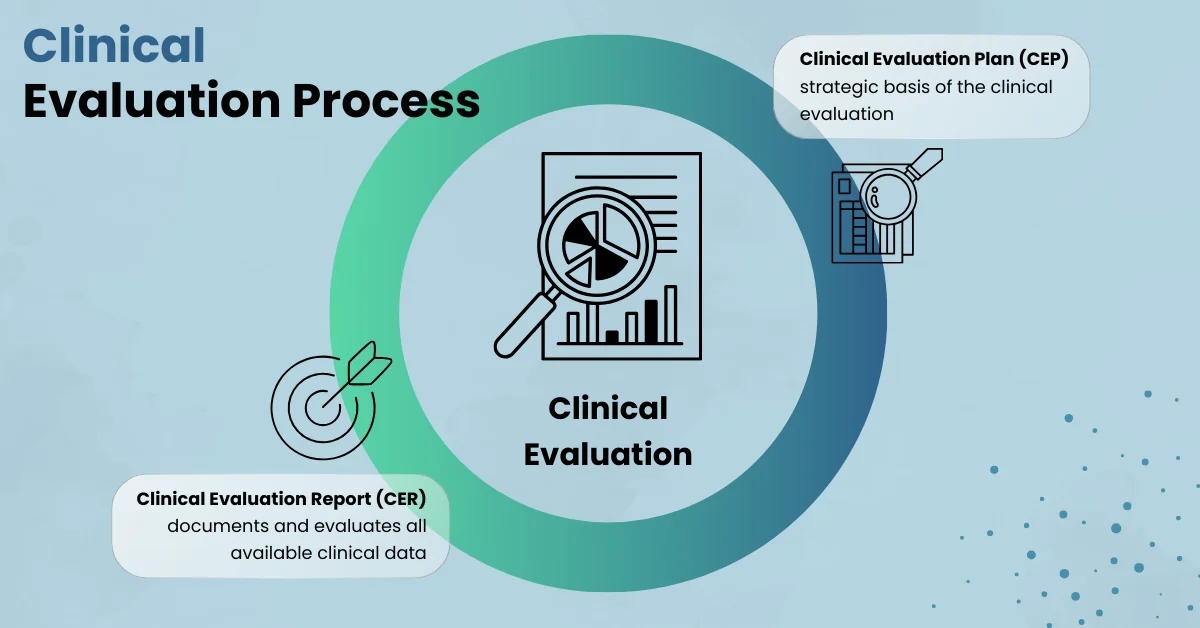
The key function of the Clinical Evaluation Plan (CEP) and Clinical Evaluation Report (CER)
The Clinical Evaluation Process is a central component of the regulatory evidence for medical devices according to the Medical Device Regulation (EU) 2017/745 (MDR). The purpose of clinical evaluation is to systematically and comprehensively demonstrate the safety, clinical performance, and risk-benefit ratio of a medical device. This is not a one-time activity, but a continuous process that accompanies the entire product life cycle.
At the center of the clinical evaluation process are two closely related documents: the Clinical Evaluation Plan (CEP) and the Clinical Evaluation Report (CER). Both are required components of the technical documentation and are of central importance for CE certification and evaluation by notified bodies.
How does the CEP form the basis of an MDR-compliant clinical evaluation?
The Clinical Evaluation Plan is the strategic and methodological basis of the clinical evaluation. Ideally, it is created at an early stage of product development and defines how the clinical evidence for a medical device should be provided. The CEP describes the medical purpose of the product and assigns it to a clearly defined indication. This forms the foundation for determining the target population, the intended users, and possible contraindications. Another key component is the description of the intended clinical benefit, which must be demonstrated in the course of the clinical evaluation.
The Clinical Evaluation Plan defines the clinical outcomes used to evaluate safety and performance, as well as the methodology for analyzing the available clinical data. The necessary measures include developing a strategy for systematic literature research and evaluating the relevance and quality of the identified data. The CEP defines both the clinical development plan and the criteria for evaluating the benefit-risk ratio. In this way, the CEP ensures that the clinical evaluation is conducted in a structured, transparent, and regulatory-compliant manner.
What does a Clinical Evaluation Report (CER) contain?
The Clinical Evaluation Report summarizes the key results of the clinical evaluation process. While the CEP describes the planning of the clinical evaluation, the CER documents the actual provision of clinical evidence. It brings together all available clinical data, subjects it to critical analysis, and evaluates it in the context of the intended purpose. In this process, both positive and negative effects are taken into account and classified in terms of their clinical relevance.
An essential component of the CER is the assessment of the clinical performance and safety of the medical device. On this basis, well-founded conclusions are drawn about the benefit-risk ratio. At the same time, the Clinical Evaluation Report serves as central evidence that the essential safety and performance requirements according to MDR Annex I are met. The CER is therefore a mandatory requirement for the CE certification and a crucial document in the testing process of the Notified Bodies.
Is the clinical evaluation process continued?
The clinical evaluation process does not end after a medical device has been placed on the market. The CER must be updated and revised at regular intervals, particularly in the context of post-market surveillance (PMS) and post-market clinical follow-up (PMCF). New insights from the market, scientific literature, or PMCF activities must be continuously incorporated into the clinical evaluation to confirm safety and clinical performance throughout the entire product life cycle.
The close interlinking of CEP and CER is crucial for a consistent, robust, and audit-proof clinical evaluation. Unclear target definitions or methodological weaknesses in the CEP have a direct impact on the quality of the CER and can lead to significant queries during audits or in dialogue with notified bodies.
WQS has been supporting medical device manufacturers for over 30 years in the creation, updating, and optimization of Clinical Evaluation Plans and Clinical Evaluation Reports. By combining regulatory expertise, clinical knowledge, and practical implementation, WQS ensures that clinical evaluations are MDR-compliant, traceable, and sustainable. Learn more: Clinical Evaluation