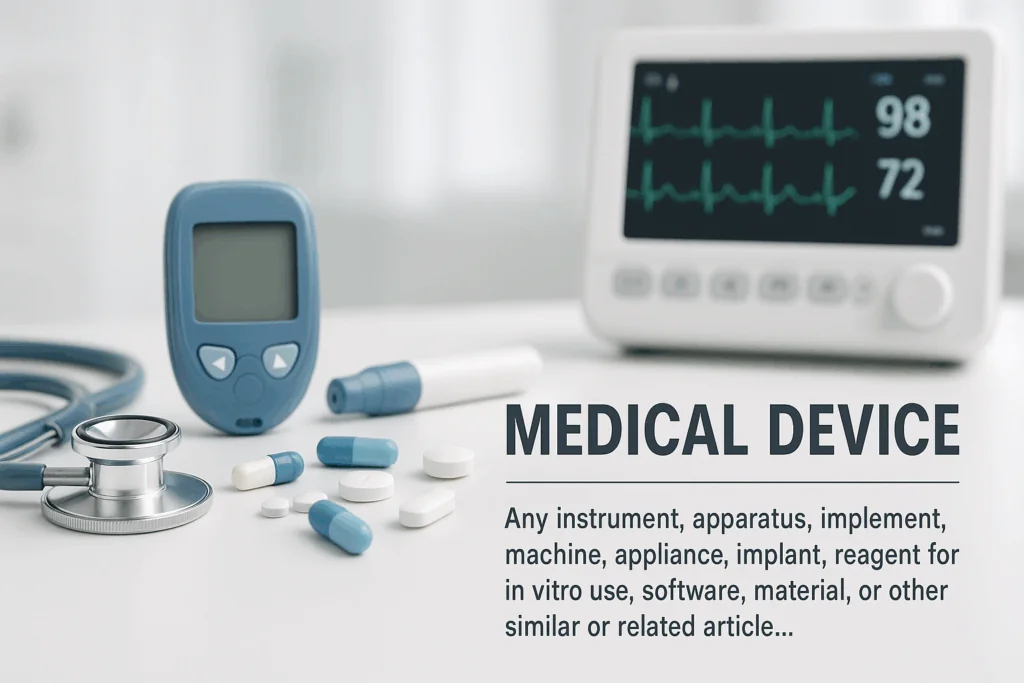
The definition of Pharmaceutical and Medical Device is a key regulatory issue in the healthcare market. Even for experts, this differentiation is not always self-explanatory. Correct classification determines the approval strategy, clinical requirements, regulatory effort, and market access.
Unlike the U.S. FDA, which clearly separates “drugs” and “devices,” the European system is guided by nuanced definitions under different sets of regulations. And in complex cases, the final classification may even be determined by a court ruling, including the European Court of Justice.
According to the legal definitions in the EU, both product groups are used for the “alleviation, prevention, and treatment of diseases.” However, the distinction is based on differentiated definitions and various regulations based on the intended main effect and the ingredient:
Medical Devices primarily act physically or mechanically.
A product is considered a medical device if it is intended for use on or in humans and serves to detect, prevent, monitor, treat, or alleviate diseases. The intended main effect is achieved through physical effects, mechanical principles of action, barrier functions, or supportive substance effects without pharmacological action.
Medical devices also serve to compensate for injuries or disabilities, or to modify or replace anatomical structures or physiological processes.
This classification is based on the legal basis of the EU Medical Device Regulation (MDR) and specifically describes:
“…all … substances and preparations of substances or other objects… which are intended by the manufacturer to be used for human beings by means of their functions for the purpose of detecting, preventing, monitoring, treating or alleviating diseases […] and whose main intended effect in or on the human body is achieved neither by pharmacological or immunological means nor by metabolism, but whose mode of action may be supported by such means…”
Typical examples include bandages, implants, diagnostic devices, and medical devices made of materials without a primary pharmacological effect.
Pharmaceuticals are substances or preparations made from substances that are intended for use on or in the human or animal body or can be administered and are intended as agents with properties for healing or alleviating or preventing human or animal diseases or pathological complaints. They are designed to restore, correct, or influence physiological functions through pharmacological processes, immunological mechanisms, or metabolic processes. The effect actively intervenes in biological processes.
The legal basis is provided by the Medicinal Products Act (AMG), which defines:
“Medicinal products are substances or preparations made from substances … that are intended for use in or on the human or animal body and are intended as agents with properties for healing or alleviating or preventing human or animal diseases or pathological conditions …”
Medicinal products are generally products for the treatment of diseases, the alleviation of complaints, or the prevention of diseases.
Regulatory classification depends heavily on how the manufacturer describes the effect. The “intended purpose,” also referred to as the “intended main effect,” is the central criterion here.
For example:
Even small differences in wording can change the regulatory category.
In addition to this classification, the intended purpose also determines the regulatory approval pathway, the clinical requirements, the extent of the conformity assessment, and the market strategy.
Borderline products are products that cannot be clearly assigned to a specific legal area. They are also referred to as “material medical devices” or “OTC medical devices (over the counter)” and are classified between medical devices, drugs, cosmetics, biocides, and nutrition supplements.
Examples include laxatives based on macrogol or weight loss products based on plant extracts.
Macrogol can be classified differently depending on the argumentation:
| Medical Device Argumentation | Pharmaceutical Argumentation |
|---|---|
| binds water | influences electrolyte balance |
| physical stool softening | metabolic processes |
| unchanged excretion |
→ The intended purpose and proven main effect are decisive.
Similar requirements also apply to the legal areas of food, dietary supplements, dietetic foods, novel foods, and functional foods.
To simplify classification and differentiation in the respective legal areas, a number of interpretative aids on the subject have been published. These documents are updated regularly and serve as guidance in regulatory borderline cases:
WQS supports manufacturers in the regulatory classification of medical devices, medicinal products, and borderline products.
Our range of services includes:
We specialize in ensuring legally compliant and efficient market access for your product.
The fundamental difference in the mode of action. A Medical Device achieves its primary intended effect typically by physical or mechanical action. In contrast, a Pharmaceutical is defined as a substance or preparation intended to exert its effect pharmacologically, immunologically or metabolically to treat or prevent disease.
Many products serve similar purposes (e.g. treatment or prevention of disease), but their mechanisms of action can overlap or be unclear, making classification complex—especially for borderline products.
The intended purpose defines how the product is supposed to work. If the primary effect is not achieved pharmacologically, immunologically or metabolically, it may be classified as a Medical Device.
Yes, so-called combination products exist. However, one mode of action must be considered primary, which determines the regulatory path (either under MDR or Pharmaceutical Law).
Yes. Key references include the “Manual on Borderline and Classification” from the EU Commission and the “Classification of Medical Devices” guidance by the AGMP Working Group. You can also contact us for support with your Classification Analyses.
WQS provides you with detailed information on your subject.
You can also explore our FAQ page and other resources for further insight
– or simply contact us for direct support.
Support for US companies to enter the European market. EU Rep, Certification, QM System, Technical Documentation, support of the Procedure, selection of a Notified Body, support of the Certification Procedure, preparation of a Clinical Evaluation, support of Clinical Studies, including the Logistical Concepts.
Copyright 2024 WQS Management Consultants GmbH – All rights reserved